

Remote Work Is Now an Organisational Resilience Strategy — The Oil Crisis Proves It
In this article, we will discuss:
- Introduction
- The oil crisis and its impact on organisations
- How governments are using remote work as an energy policy
- What organisational resilience actually requires
- Remote work reduces energy exposure — the numbers
- Labour market flexibility and operational continuity
- The limits: what remote work can and can’t do
- What this means for your organisation right now
- Frequently asked questions
- References
Introduction
The IEA’s number-one advice for surviving the 2026 energy crisis? Tell your people to stay home. Here’s what that means for how organisations need to think about their own resilience — right now.
When oil prices surged past $100 a barrel following the closure of the Strait of Hormuz in early 2026, the International Energy Agency did something that would have seemed unthinkable just a few years ago: it published an official list of emergency demand-side measures, and work from home was number one on the list. [1]
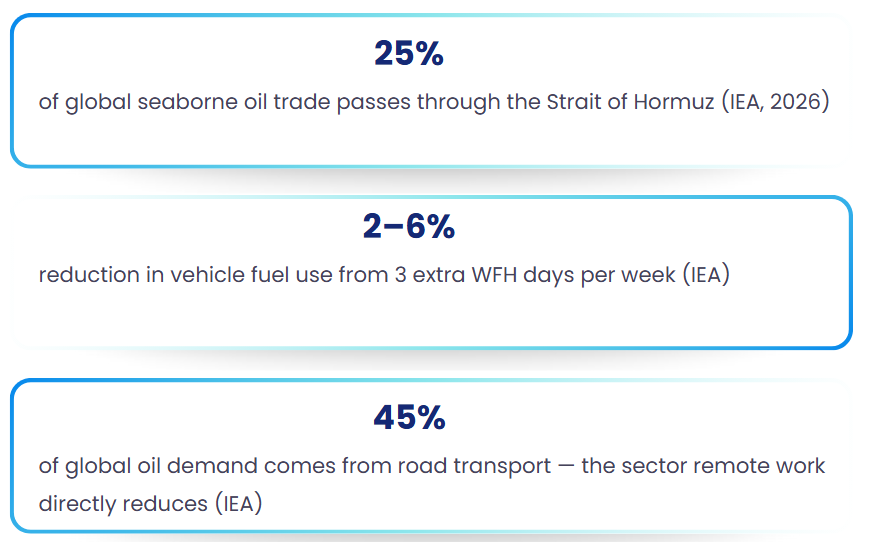
The Iran war has triggered what the IEA itself called the largest oil supply disruption in the history of global energy markets — surpassing even the 1970s shocks. Around 20–25% of global oil supply normally passes through the Strait of Hormuz. When that corridor closed, governments scrambled for every lever they had. And one of the most effective turned out to be asking knowledge workers to skip the commute.
For organisations still debating whether remote work is a perk or a productivity risk, this should settle the question. Remote work is an energy security and organisational resilience tool — and the crisis has made that impossible to ignore.
The oil crisis and its impact on organisations
Since US and Israeli strikes on Iran began in late February 2026, oil prices have been on a relentless upward trajectory. Beyond the headline crude price, organisations are feeling the effects through multiple channels: higher logistics costs, rising energy bills for offices and warehouses, constrained air travel for business, and disrupted supply chains for any product that moves by sea through the Gulf. Analysts at Kpler warned that if the Hormuz closure continued for two more months, supply risks would rise sharply. [1]
For organisations, this translates directly into cost pressure and operational uncertainty. The businesses absorbing this best are those that already had distributed, digitally enabled workforces — not because they anticipated a war in the Persian Gulf, but because resilience built for one kind of shock tends to work for others too.
The IEA issued official guidance to governments, businesses, and households to reduce oil demand. Remote work was listed as the primary immediate action, alongside reducing speed limits, encouraging public transport, and restricting private car use in cities. (IEA, March 2026)
- Work from home where possible — displaces oil use from commuting
- Reduce highway speed limits by at least 10 km/h
- Encourage shift from private cars to public transport
- Alternate private car access to roads in large cities
- Increase car sharing and adopt efficient driving practices
- Cut business air travel — potential 40% reduction in short-term (IEA)
How governments are using remote work as an energy policy
This is not just theory. Governments across Asia and Europe have already deployed work-from-home mandates as emergency energy conservation measures — this is the second time in four years they have done so, after the 2022–23 European gas crisis triggered similar responses.
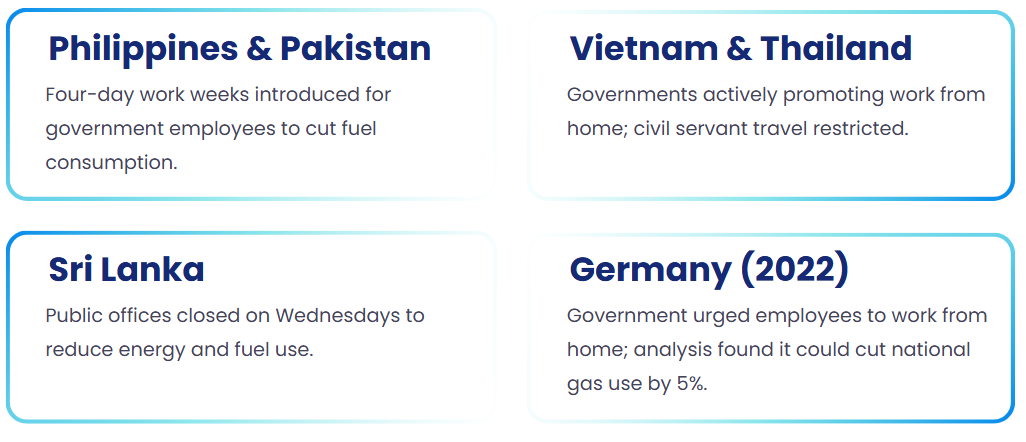
The pattern is consistent. When physical fuel becomes scarce or expensive, governments that can redirect knowledge workers to home offices immediately reduce demand on the transport system without reducing economic output. [1, 2]
What organisational resilience actually requires
The academic framework that best captures this comes from Martin and Sunley’s landmark 2015 paper in the Journal of Economic Geography, which defines resilience not as surviving a shock intact, but as the capacity to resist, adapt, and — crucially — transform. They identify five structural pillars: economic diversification, labour market flexibility, financial buffers, governance continuity, and the ability to evolve over time. [3]
Remote work directly reinforces three of these. It makes labour markets more flexible by decoupling productivity from physical location. It supports operational continuity when physical access is disrupted. And it reduces an organisation’s exposure to one of the most volatile cost inputs in any oil-shock scenario: transport.
“Resilience does not merely entail a return to a pre-existing state — it requires the capacity for transformation and the creation of new growth paths.”
— Davoudi, Planning Theory and Practice, 2012 [4]
Briguglio and colleagues, in their foundational 2009 paper in Oxford Development Studies, defined economic resilience partly as the capacity to make policy-induced adjustments that absorb external shocks. For organisations, that means building the systems — remote infrastructure, digital processes, distributed teams — before the shock arrives, not after. [5]
Remote work reduces energy exposure — the numbers
Road transport accounts for roughly 45% of global oil demand. A significant portion of that is commuting. The IEA calculated in 2020 that if every worker able to work from home did so for just one extra day per week, it would save around 1% of global oil consumption for road transport annually. Three days of remote work per week reduces vehicle fuel consumption by 2–6%. [6]
A 2023 study in the Proceedings of the National Academy of Sciences found that switching fully from onsite to remote work can reduce up to 58% of work’s carbon footprint — primarily through eliminated commuting and lower office energy use. The IEA’s 2026 guidance reflects these figures: working from home is the fastest available lever for reducing transport fuel demand without affecting economic output. [7]
For individual organisations, the maths is similarly compelling. Every employee who skips a daily commute removes that fuel demand from the equation — demand that, in a crisis like 2026, drives up costs for everyone including the logistics, aviation, and energy-intensive operations that cannot be relocated to a kitchen table.
Labour market flexibility and operational continuity
The Gulf crisis didn’t just raise fuel costs — it disrupted aviation corridors, raised shipping insurance premiums, and made physical movement expensive and uncertain. Research published in the Journal of Regional Science in 2025 found that remote work and digitalisation enhance labour market resilience by allowing organisations to maintain employment and productivity despite disruptions to normal commuting patterns. [8]
McKinsey documented in 2024 how the engineering firm Egis maintained full operations throughout the Ukraine conflict by rapidly pivoting to remote work — a real-world demonstration that the technology and the organisational model, once in place, is genuinely robust to physical disruption. [9] The same model applies whether the disruption is a conflict, a pandemic, or an energy price shock that makes commuting prohibitively expensive for employees.
The limits: what remote work can and can’t do
The case for remote work as an organisational resilience tool has real limits. Only around one-fifth of workers globally can perform their jobs remotely — a ceiling determined by role, sector, and infrastructure access. Research from the US Economic Report of the President (2025) found remote work rates of 36.5% for degree-educated workers but only 7.7% for those with a high school diploma. The resilience benefits flow primarily to knowledge-economy organisations. [10]
The Oxford Internet Institute’s 2022 analysis in PLOS One also found that remote work opportunity is globally polarised — concentrated in North America, Europe, and parts of South Asia, with the Global South largely excluded. Countries and organisations without adequate digital infrastructure cannot access these resilience benefits even when they need them most. [11]
What this means for your organisation right now
The IEA’s formal recommendation is addressed to governments, but the operational implication lands squarely on organisations. If your workforce can work remotely and doesn’t have the infrastructure to do so effectively, that is a resilience gap — one that the 2026 oil crisis has just made very visible.
The practical checklist is not complicated: reliable broadband for remote employees, collaboration tools that work without a corporate network, policies that normalise hybrid and remote work rather than treating it as a concession, and leadership that doesn’t conflate presence with productivity. None of this is new. What the oil crisis has done is reframe it — from a talent retention and culture question to an energy security and business continuity question.
Organisations that built remote work capability before the crisis didn’t do so to survive a Persian Gulf oil shock. But that’s exactly what the investment turned out to protect them from.
Hybrid and fully remote work was already improving employee retention without damaging productivity, according to Bloom et al.’s 2024 paper in Nature. [12] The oil crisis adds a further dimension: it is also an energy cost hedge, a supply chain buffer, and a continuity plan. Organisations that have built this capability have, without necessarily meaning to, built genuine resilience. Those that haven’t now have a concrete, pressing reason to start.
Frequently asked questions
The IEA made remote work its primary demand-side measure because road transport accounts for around 45% of global oil demand, and commuting is a large part of that. Working from home three days a week can reduce personal fuel consumption by 2–6% — a meaningful impact during the largest oil supply disruption in history. Governments from Vietnam to the Philippines to Germany have already deployed this policy.
Remote work improves organisational resilience in three main ways: it reduces exposure to fuel cost volatility by eliminating commuting, it enables operational continuity when physical access to offices is disrupted, and it gives organisations access to a distributed talent pool that doesn’t depend on any single location or transport infrastructure.
Indonesia, Vietnam, Thailand, the Philippines, and Pakistan have all introduced mandatory or strongly encouraged work-from-home policies for government employees. Sri Lanka shut public offices on Wednesdays. Across Europe, governments have urged employees to avoid commuting to reduce fuel demand — mirroring the measures taken during the 2022–23 Russian gas crisis.
Yes, with caveats. The IEA estimates that one extra day of working from home per week globally saves around 1% of global oil consumption from road transport annually. Three days saves 2–6% of commuting fuel. A 2023 PNAS study found full remote work can cut up to 58% of work’s carbon footprint. The impact is real but applies only to the roughly 20% of workers who can work remotely.
References
- International Energy Agency (2026). IEA urges swift cuts in oil demand, encourages remote work, less air travel. Euronews, 20 March 2026; CNBC, 20 March 2026.
- Fortune (2026). The Iran war is reviving remote work across the world — from Denmark to Vietnam. 12 March 2026.
- Martin, R. and Sunley, P. (2015). On the notion of regional economic resilience: Conceptualization and explanation. Journal of Economic Geography, 15(1), 1–42.
- Davoudi, S. (2012). Resilience: A bridging concept or a dead end? Planning Theory and Practice, 13(1), 299–307.
- Briguglio, L., Cordina, G., Farrugia, N., and Vella, S. (2009). Economic vulnerability and resilience: Concepts and measurements. Oxford Development Studies, 37(3), 229–247.
- IEA (2020). Working from home can save energy and reduce emissions. But how much? International Energy Agency Commentary, 12 June 2020.
- Obringer, R. et al. (2023). Climate mitigation potentials of teleworking are sensitive to changes in lifestyle and workplace. Proceedings of the National Academy of Sciences, 120(39), e2304099120.
- Yahmed, S.B. et al. (2025). Local labour market resilience: the role of digitalisation and working from home. Journal of Regional Science, 65(5), 1506–1532.
- McKinsey & Company (2024). A proactive approach to navigating geopolitics is essential to thrive. McKinsey Insights, November 2024.
- US Council of Economic Advisers (2025). How Remote Work is Reshaping the Economy. Economic Report of the President 2025, Chapter 2.
- Kässi, O. and Lehdonvirta, V. (2022). The global polarisation of remote work. PLOS One, 17(10), e0274630. Oxford Internet Institute.
- Bloom, N., Han, R., and Liang, J. (2024). Hybrid working from home improves retention without damaging productivity. Nature, 630, 920–925.

